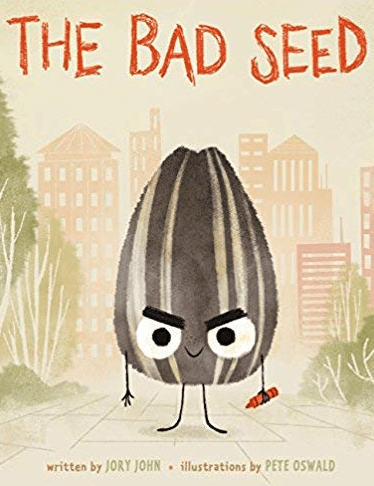
I love this book. When I worked as a therapist in a residential treatment facility, all of my coworkers knew about my obsession with The Bad Seed. I mentioned it nearly every time someone asked for an idea for a therapy session–even group therapy for 16-18-year olds (and it went over well with them, after some initial grumbling).
The story begins on the face of a healthy sunflower, where the seed and his family are happy together, playing instruments and partying. Soon enough, the seed is harvested and separated from his family. His journey is rough and life-threatening. He changes. He loses touch with his joy and becomes a tough character, abrasive and self-isolating. Those in the know will recognize this as a common pattern for adults and children who’ve experienced trauma.
Eventually, the seed realizes his own misery and decides to change. After a vagrant life, living in a coke can, he decides to soften his approach. It’s not easy, and he doesn’t always succeed, but he makes enough progress to lose the “Bad Seed” label.
I read this book with kids in group and individual therapy over and over. My clients were young and had been through too much. In response, they fought back, often at the wrong time and place. They could be violent and destructive in attempts to feel some control and safety. This earned them the “bad” label that sent them to treatment. This book is light and fun, with clever illustrations and a tongue-in-cheek storyline, but it’s so much more than the sum of its parts. It’s a roadmap for the traumatized person to take control of their life and fight back in a more constructive way. The solution becomes to form connections, rather than shun them, and to give oneself grace, rather than self-blame.
In psychodynamic therapy there are four stages: identification, catharsis, insight, and universalization. First, we see ourselves reflected in the story and the characters. Then we feel an emotional release (catharsis) that leads to some realizations or insights about the story we’re reading and the stories we’ve lived. Lastly comes the recognition that we aren’t the only ones who feel what we feel, and others, even a cartoon seed, have experiences that can guide us to healing.


 A Therapist's Book Club